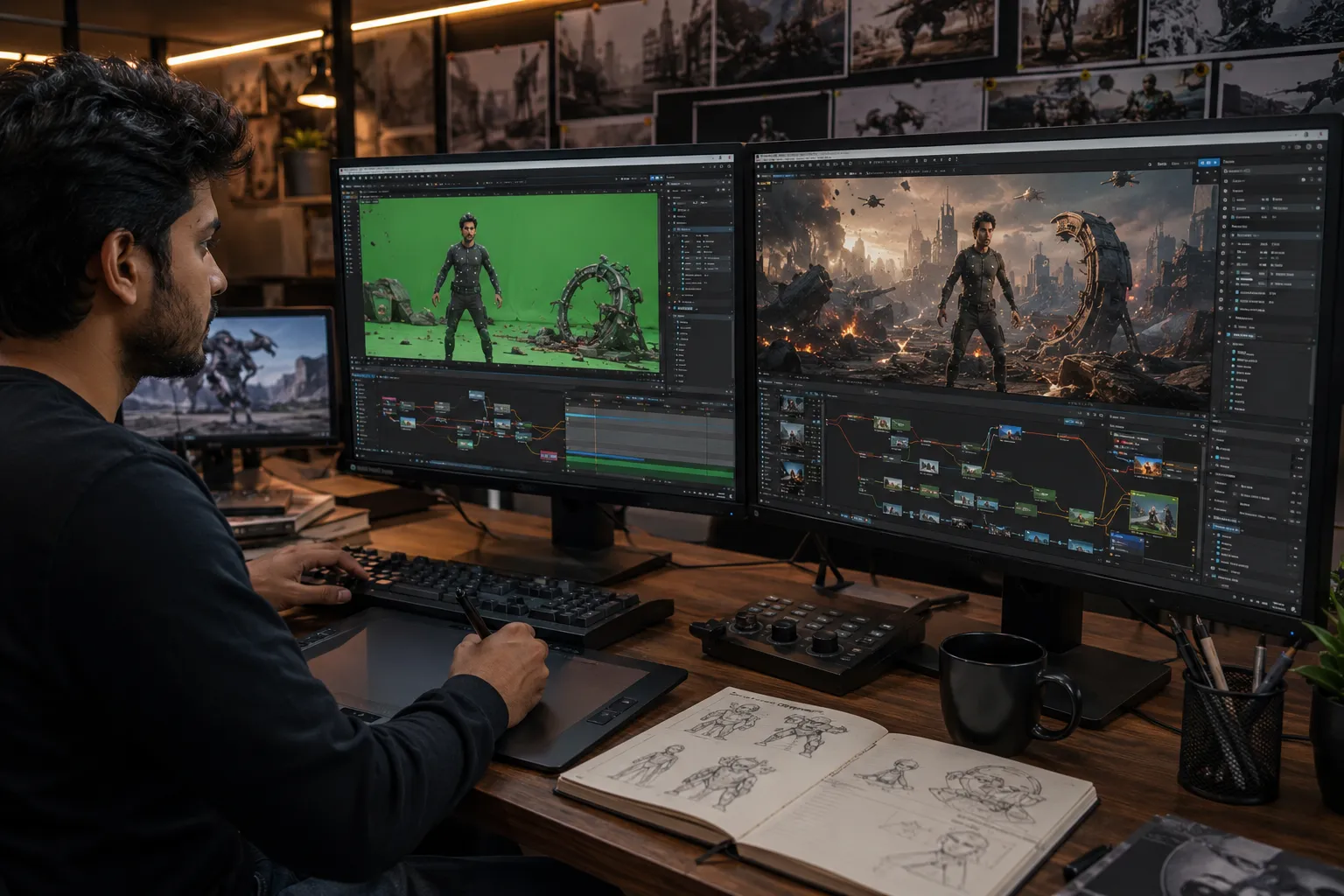
Behind the Scenes: How VFX Brings Movies to Life
Have you ever wondered how superheroes fly, dinosaurs roam the earth, entire cities are destroyed, or alien worlds appear so realistic on screen? The answer lies in Visual Effects (VFX).
VFX has transformed modern filmmaking by allowing creators to bring impossible ideas to life. From blockbuster Hollywood productions to Indian films and OTT content, visual effects play a crucial role in storytelling.
What is VFX?
Visual Effects (VFX) refers to the process of creating or manipulating imagery outside live-action filming. It combines real footage with computer-generated elements to create scenes that would be dangerous, expensive, or impossible to shoot in reality.
Today, VFX is used in:
- Movies
- Television Series
- OTT Productions
- Advertisements
- Gaming Cinematics
- Music Videos
- Virtual Production
The VFX Production Pipeline
Creating visual effects involves multiple specialized stages working together.
1. Pre-Production
Before filming begins, artists create concepts, storyboards, previs animations, and visual plans that help directors visualize complex scenes.
2. Green Screen Filming
Actors often perform in front of green or blue screens. These backgrounds are later replaced with digital environments during post-production.
3. Matchmoving & Motion Tracking
VFX artists track camera movement and object motion so digital elements perfectly match the live-action footage.
4. 3D Modeling & Asset Creation
Artists build digital characters, creatures, vehicles, buildings, environments, and props using advanced 3D software.
Digital characters and objects are animated to move naturally and interact realistically with live-action footage.
6. Simulations
Complex effects such as fire, smoke, explosions, water, destruction, and weather systems are generated using simulation tools.
7. Compositing
Compositors combine all elements into a final seamless shot, ensuring proper lighting, color, shadows, and realism.
Popular VFX Techniques Used in Movies
- Green Screen Compositing
- CGI Character Creation
- Digital Environments
- Particle Effects
- Motion Capture
- Camera Tracking
- Digital Doubles
- Matte Painting
- Rotoscoping
- Color Grading
Software Used by VFX Professionals
- Adobe After Effects
- Nuke
- Autodesk Maya
- Blender
- Houdini
- Cinema 4D
- Unreal Engine
- Substance Painter
- ZBrush
Career Opportunities in VFX
The demand for skilled VFX professionals continues to grow across film, television, advertising, gaming, and streaming platforms.
Popular VFX job roles include:
- VFX Artist
- Compositor
- Matchmove Artist
- Roto Artist
- 3D Modeler
- FX Artist
- Lighting Artist
- Environment Artist
- CG Generalist
- VFX Supervisor
VFX Salary in India (2026)
- Beginner (0–1 Year): ₹3 LPA – ₹5 LPA
- Junior Artist (1–3 Years): ₹5 LPA – ₹8 LPA
- Mid-Level Artist (3–5 Years): ₹8 LPA – ₹15 LPA
- Senior VFX Artist: ₹15 LPA – ₹25 LPA+
- Freelancers & International Artists: Higher earning potential
Future of VFX
The future of VFX is being shaped by AI-assisted production, real-time rendering, virtual production, and advanced simulation technologies. Streaming platforms, gaming studios, and film industries are investing heavily in visual effects talent.
Artists who combine VFX, animation, 3D design, and AI-powered creative tools will have excellent career opportunities in the coming years.
Final Thoughts
VFX is the invisible magic behind many of the world's most memorable movie moments. Whether creating futuristic worlds, epic battles, realistic creatures, or breathtaking environments, VFX artists help turn imagination into reality.
For creative individuals interested in technology, filmmaking, and digital artistry, a career in VFX offers exciting opportunities, strong growth potential, and the chance to work on projects seen by millions of people worldwide.